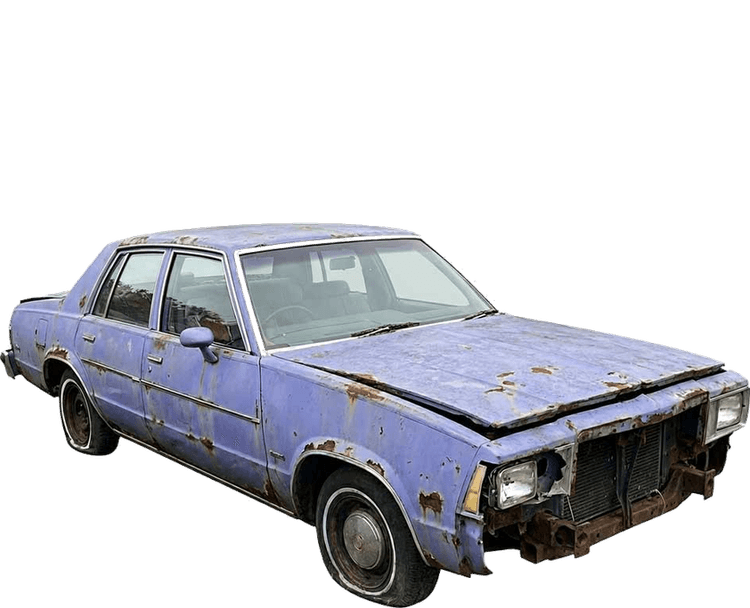
If you searched “$500 cash for junk cars” or “$1,000 for junk cars,” you are really asking one thing: will I get a real number, or a lowball? Both figures are reachable, but neither is automatic. What you get comes down to your car’s weight, its catalytic converter, its parts, whether it runs, and the scrap market where you live. Here is the honest breakdown of what it takes to hit each one.
Can You Get $500 for a Junk Car?
Often, yes. A complete vehicle, one that still has its engine, transmission, and catalytic converter, usually clears $500, even when it does not run. The reason is simple: a typical sedan weighs 3,000 to 4,000 pounds, and the scrap metal alone puts a floor under the price. Add an intact catalytic converter and a few sellable parts, and most complete cars land at or above $500.
What pulls an offer below $500:
- A missing or stolen catalytic converter, which can take $100 to $300 off on its own
- A missing engine or transmission, the two heaviest valuable components
- A car that has been stripped for parts before pickup
- A very light vehicle, like a small older compact, with little scrap weight
So the short version: if your car is complete and still has its converter, $500 is a realistic expectation in most markets. If pieces are already gone, plan for less.
What Junk Cars Are Worth $1,000 or More?
The $1,000 mark is a different tier. The vehicles that reach it share a pattern: more weight, stronger parts demand, or both.
- Trucks, SUVs, and vans are the most common $1,000-plus junk vehicles. They are heavier, so the scrap value is higher, and their parts (beds, doors, drivetrains) stay in demand.
- Vehicles that still run and drive are worth more than non-runners, because the buyer can resell usable components or even the whole car.
- Newer or popular models with parts people actually search for pull more than obscure or very old ones.
- A clean title and an intact catalytic converter push you toward the top of the range.
A complete, running half-ton pickup can clear $1,000 comfortably. A light, non-running, partly stripped sedan almost never will, no matter how it is advertised.
The Quick Breakdown
| Vehicle and condition | Realistic range |
|---|---|
| Complete car, runs and drives | $500 to $1,500 |
| Complete car, starts but needs work | $300 to $800 |
| Complete car, non-running | $200 to $600 |
| Truck, SUV, or van, runs | $1,000 to $2,500 |
| Truck, SUV, or van, non-running | $500 to $1,200 |
| Stripped or missing major parts | $75 to $400 |
These are general ranges. Your real number depends on the local scrap rate and what your specific vehicle’s parts are worth that week. You can work out your own floor first using the scrap value calculation.
What Moves the Number Up or Down
Five things decide where you land:
Scrap weight. Heavier vehicles are worth more at the floor. This is why trucks beat sedans.
The catalytic converter. This single part swings the offer more than almost anything else. An intact converter is worth real money; a missing one is the most common reason an offer comes in low. Learn more in our guide to catalytic converter value.
Parts demand. A buyer who can resell your alternator, doors, or wheels pays more than one who only scraps the shell.
Whether it runs. Running and driving beats non-running, which beats wrecked or stripped.
Your local scrap market. Prices per ton vary by region and by month. A dense metro with competing recyclers tends to pay more than a rural area. For the full mechanics, see how junk car prices are calculated.
How to Actually Get the Most Cash
The difference between a $300 offer and a $600 offer on the same car usually comes down to a handful of moves:
- Do not strip the car first. Pulling the catalytic converter, engine, or wheels to sell separately almost always nets you less, because those parts were propping up the offer. The whole car is usually worth more than the sum of what you would part out.
- Describe it accurately. Name the real problem (“blown engine,” or “converter was stolen”) rather than something vague. An honest description gets you an offer that holds at pickup instead of a number that gets cut when the truck arrives.
- Get three to five quotes. Different buyers value the same car differently. Comparing a Clunqr offer against another online quote and a local scrap yard can move your payout meaningfully.
- Demand a guaranteed offer with free towing. Ask directly: is this price guaranteed as long as the car matches what I described, and is towing free with nothing deducted? If a buyer hedges, move on.
- Have your title sorted. A clean title in your name brings the best offer; no title is often still workable with registration.
- Do not spend money fixing or cleaning it. Junk buyers price on weight, parts, converter, and title, not curb appeal. Washing, repairs, and new tires add nothing.
For the full step-by-step playbook, including how to calculate your scrap floor and what your specific make and model is worth, see our complete guide on how to get the most cash for your junk car.
Get a Real Number for Your Car
The only way to know whether your car is a $500 car or a $1,000 car is a real offer on your exact vehicle. Clunqr gives you a guaranteed price in about 90 seconds, with free towing and cash at pickup. The number you see is the number you get.
Selling in a specific city? Clunqr works with vetted local buyers across the country. Find your local junk car buyer now.